
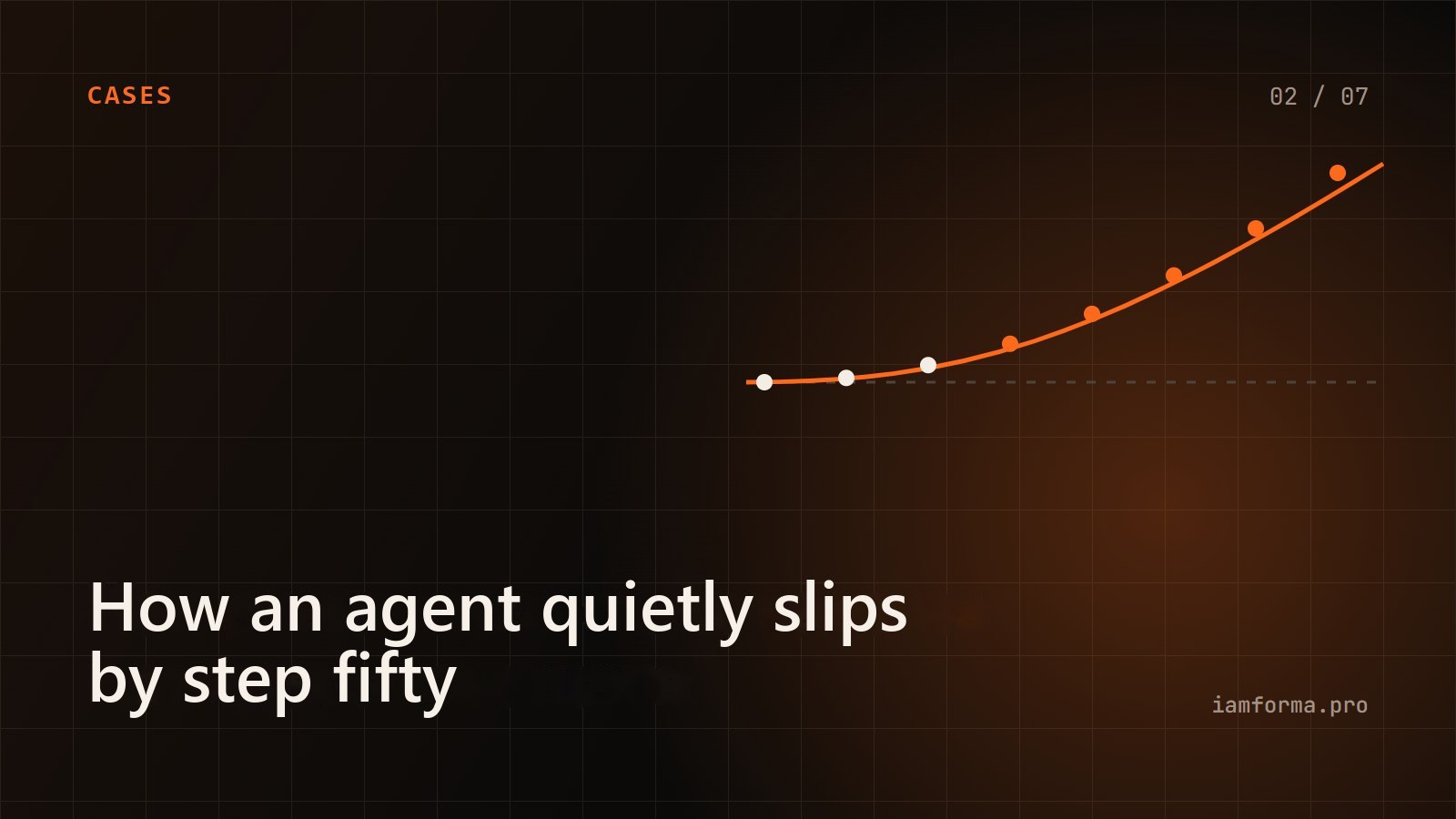
An agent that works alone for a long time in a continuous context rarely breaks abruptly. More often it degrades quietly, and from the outside this looks like normal work for a long time. Let’s break down this failure step by step.
Symptoms
1. Impression instead of verification. Accumulated context replaces reconciliation against facts with the feeling that “usually everything is fine.” If the last three checks passed smoothly, the fourth one is already checked against expectation, not against the criterion.
2. Early decisions shift later ones. Each decision is made in the shadow of the previous ones. An imperceptible tilt at the start sets the direction for everything that follows.
3. Something similar instead of the same thing. Execution gradually drifts from the original intent toward something similar. Everything looks reasonable, but the result is already different.
Both the labs that build models and everyone who builds agent systems on top of them are working on this problem right now: how to keep an agent accurate not at minute five, but at step fifty.
What the protocol does
“Forma” answers not with the advice “be more careful,” but with its design:
- Isolation.
Spec,Kit,RunandCore— separate calls without shared memory. Each starts from a clean slate and ends with its result. There is physically no way to carry an impression over from a previous pass. - Reconciliation against the recorded criterion. Each task is checked against the readiness criterion from the card, not against how the previous checks went.
- No one checks themselves. The result is accepted by the next node, not by the one who made it.
Special case: Intent
Intent — the only node with real memory: it runs one continuous session with the human and technically forgets nothing. So on item-by-item reconciliation, its lack of memory is a discipline it imposes on itself. It deliberately reconciles each task only against the criterion from the card.
Summary
Quiet degradation is not cured by attention: from the inside it does not feel like an error. It is caught by form: isolation, a recorded criterion, and a separate checker.


Comments