
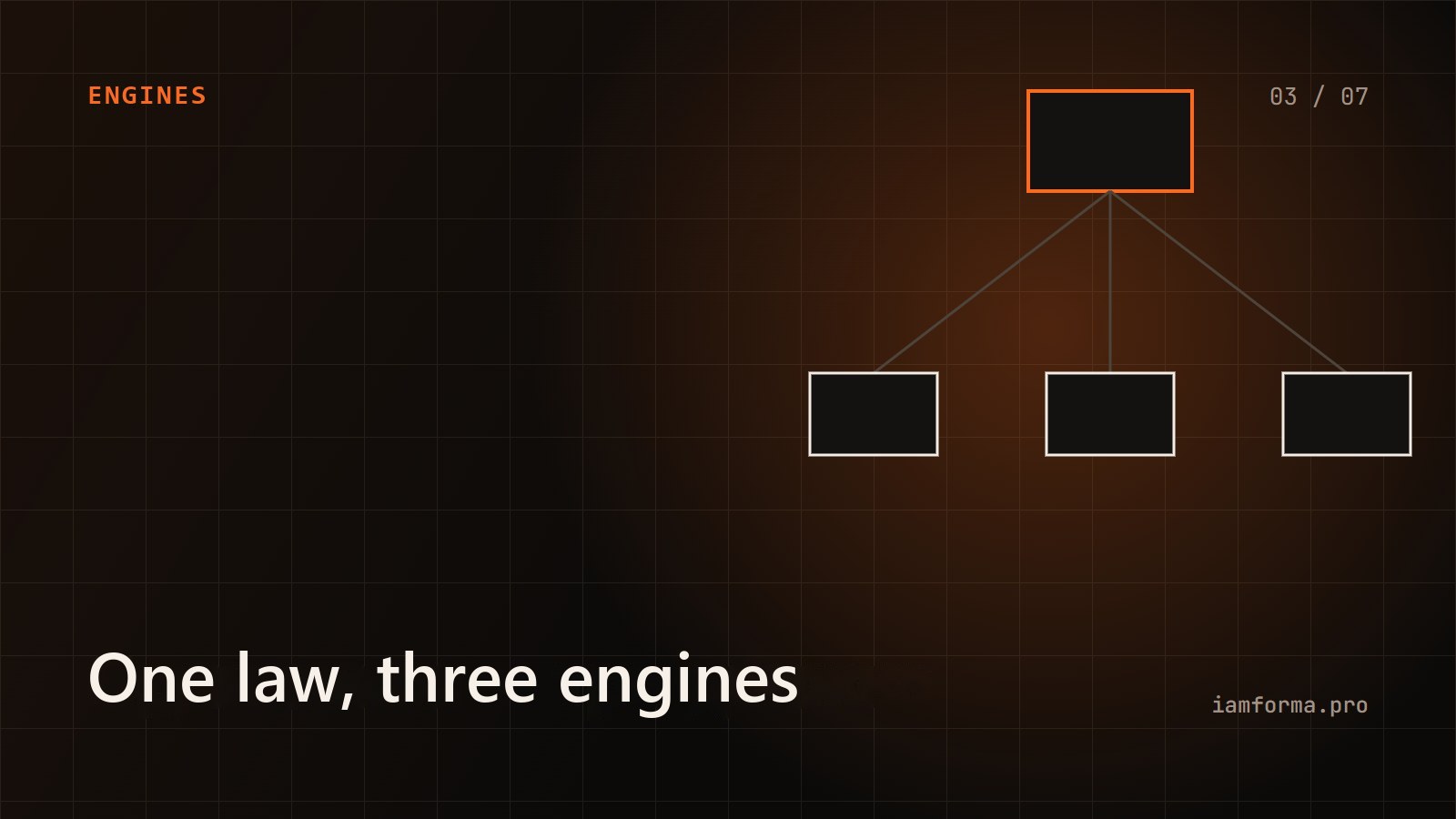
The Protocol “Forma” works in Claude Code, Codex and Gemini. The node behavior rules are not copied three times: they are written once and apply identically in any environment.
Where the law lives
The protocol’s law is a file AGENTS.md at the project root, sections 1–7: five pairs, route, thresholds, position marker, prohibitions, card, board. Each engine loads it into every agent, either directly or via a one-line import:
- Claude Code reads
AGENTS.mditself; - Codex reads it as the root
AGENTS.md; - Gemini pulls it in with an import from its own file.
Root CLAUDE.md is deliberately absent: it would shadow native reading and become a second copy of the law.
What is specific to each engine
Everything specific to one engine lives only in its own file, in section 8, and never in the law:
| Engine | File §8 |
|---|---|
| Claude Code | .claude/rules/claude-8.md |
| Codex | .codex/CODEX-8.md |
| Gemini | .agents/rules/gemini-8.md |
It describes where the node roles live, which models they run on, how a subagent is invoked, in which fields a call’s spend arrives, and where hooks and MCP are configured.
If an engine cannot isolate
An engine that cannot invoke a separate agent still runs the route, but in degraded mode, and says so in advance. Stages are separated by explicit markers, and checking relies only on inspected facts. Such an engine takes only what a weak check can hold: tooling, a small fix, a card with an attempt budget of one.
Why the schema is in English
Schema files are written in English. Four reasons:
- The model’s native language is cheaper. About 39% token savings for the same meaning, measured on real paragraphs of the schema.
- Prompts are written by agents for agents. When internal exchange runs in the model’s native language from the source, meaning does not blur at the translation boundary.
- Distortions are spread across nodes. The loss of one node must be caught by the next, whose check is built differently.
- The mechanism does not depend on scale. As the project grows, the number of executors grows, while the form stays the same.
Summary
One law, three adapters. An engine can be swapped, and the rules of the game stay the same.

Comments