
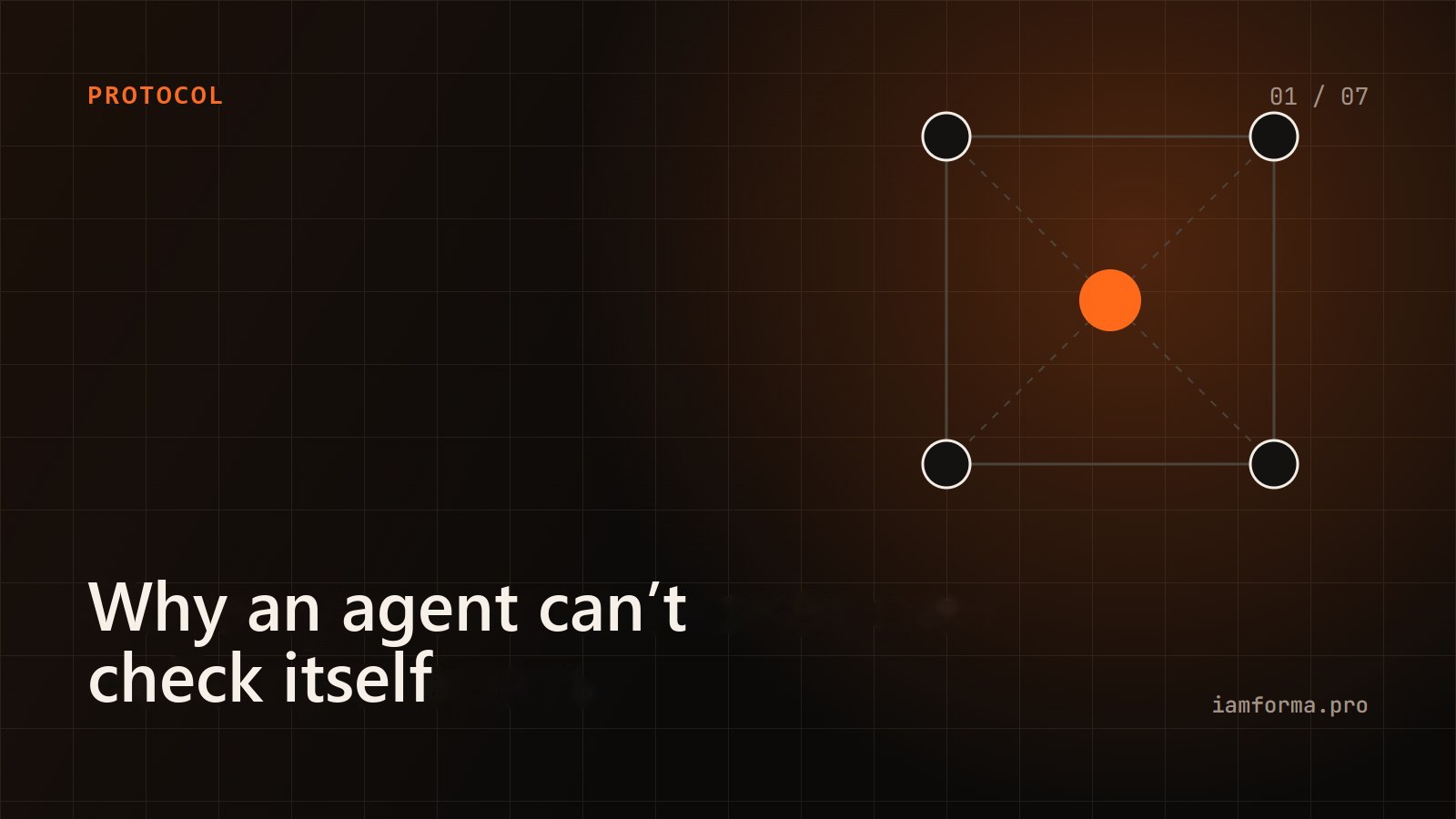
The first and hardest rule of the Forma protocol is simple: no one confirms their own work. Everything else grows out of this rule, including the fact that there are five nodes, not one.
Conviction without an opponent
Imagine one process that does everything: it devises the Result Image, cuts it into tasks, prepares the tools, executes, and at the end decides by itself whether it reached the goal. It may be sure of every step, but its certainty weighs nothing: there is no one to dispute it. Each next step rests on the conclusions of the previous one, and there is nothing to check them against except its own impression.
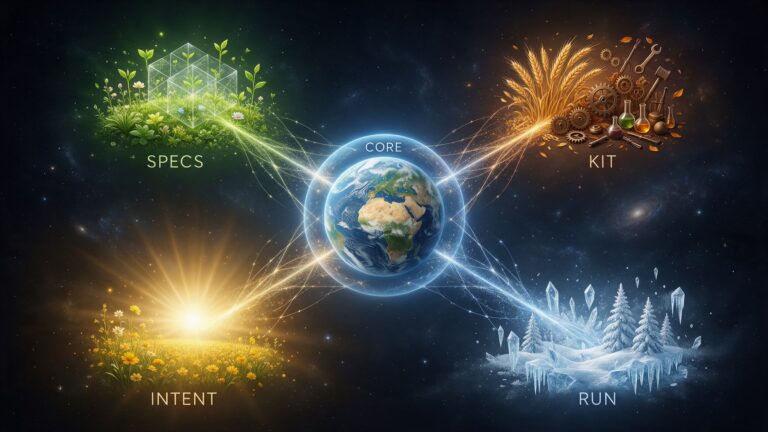
Five nodes are not bureaucracy. This is the literal implementation of the ban on self-checking: each next node receives someone else’s result and must stumble over it if it is incomplete.
Each node has its own pair
Each of the five nodes has two criteria. The first judges one specific circle, the second decides whether what was done stands up next time as well:
Intent: beautiful · just;Spec: simple · complete;Kit: natural · lawful;Run: honest · humane;Core: individually · the true path.
The difference between the two halves is why one node is not enough. If the second half is lost, each criterion degenerates: beauty into superficiality, simplicity into truncation, honesty into formality.
Judge without a stake
Core stands aside not because it is smarter than the others. It has no stake in the result. It proposes no content; it only repairs the tooling of the node named as the cause of the discrepancy, and slips back into the shadows. The one who approved the image cannot be the one who accepts it impartially. When these roles are combined in one place, the system returns to where it came from: to self-confirmation.
Not control for the sake of control
Five nodes exist so that a discrepancy — a generalized image, an unsliced task, a misunderstood tool, a quiet substitution — is caught by the one who by their role is obliged to react to it. Otherwise one can only hope that this time it will pass.

Comments